

/
Why “Career Coaching” within all organisations is fundamental for a harmonious workplace and business success

• The Challenge
Staff retention has been a major issue for most companies, particularly post-pandemic. This has been fuelled by a multitude of factors ranging from general dissatisfaction, challenging geopolitics, hybrid working, lack of leadership engagement, business uncertainty, poor transparency in the workplace and a lack of career pathways, amongst many other factors.
Traditionally, companies have valued individual or team performance over loyalty, but that is now changing.
• The Necessity for “Active” Career Progression
If you look back at your career and that of your colleagues, you can see that we all started out full of hope on the basis that we would progress at a steady rate, we accepted that there would be a few challenges along the way, but if we did the work, built, and maintained relationships, things would happen for us.
In reality, a passive approach to career development can be totally dependent on luck and to a certain extent being in the right place at the right time. Furthermore, what happens to a lot of employees is that they get so embroiled in their day to work that they have no time to reflect for themselves. Decisions on desired career paths – for example, technical versus managerial/leadership roles, is often not evaluated for the benefits and matching aptitude, attitude, personality, and skill sets.
Taking Control
One of our associates shared with us that when he was working in an operational job with significant responsibility and long hours, he had literally no time to think or reflect. In that period, he had transferred considerable knowledge to staff and associates. In addition, he had only been on one minor half-day training course during his tenure.
Then, out of the blue came a shock announcement about the impending factory closure. It was only at this point that he had the opportunity to reflect on his career pathway. Fortunately, he was one of the few that was relocated in the organisation. Later, at the time of his exit interview from the site, he made a pledge to reinvent himself through personal training and development every 3 years. On this basis he would plan his career accordingly.
• Approaches for Career Progression & Transition
In order to think about your career adequately then individuals need to be clear on what motivates them.
This can change at different stages of your career, because of personal circumstances, such as family as well as motivation, but also your personal attributes.
What is success?
Success can mean different things to different people based on these attributes. It can mean, a title, position level or the ability to have freedom to operate with some level of independence and /or intellectual challenge.
Quite often people focus on one area, such as position or status, because as that is associated to an extent with financial reward and benefits, but also to an extent that is the way we have been programmed from a younger age.
Looking Internally
Plenty of organisations do recognise individual contributors based on their level of creativity and /or risk taking. The challenge for managers and HR functions is to recognise this and communicate it properly through effective and transparent communication.
Our dedicated career coach Paul Holmes cites many instances when he was in recruitment where firms mistakenly went “outside” when there was plenty of other talent internally, either in another division or region.
Hybrid working means that this is even easier because physical relocation is no longer necessary in most cases. Hybrid work even further entangles one’s work life with their personal life and that balance must ideally be managed well.
Work-Life Balance
There are two other career attributes that an individual should consider: job security and personal wellbeing, such as work-life balance.
The current thinking is that you should not distinguish too hard between work and life but see them as a continuum and manage wellbeing in both areas as it is easier to manage and comprehend. For those on the TCB team, this has been a reality for many years!
Be Active
At Team Coaching Boutique® we recommend that individuals take time out and set aside time to reflect on these. We have worked with plenty of professionals who think that they just need to climb the organisation for status, recognition, and reward, when in fact they can contribute in other ways and coincidentally be much happier and less stressed.
The Four Stages™ of Contribution Model was developed years ago by Gene Dalton and Paul Thompson. This model identifies the stages in which leaders participate and develop and describes what high performance is in each stage—Contributing Dependently, Contributing Independently, Contributing Through Others, and Contributing Strategically. Using this or similar, organisations can develop diverse talent pools, improve, performance, ROI, and staff retention.
One thing is clear, employees these days need to take an active approach to their career progression and reflect, rather than reflecting on a passive approach.
• What do you do when you are faced with difficult career choices?
Once you have given due consideration all the factors we have mentioned earlier in this article, you may have to consider your options beyond your company boundaries.
These decisions should not be taken lightly; there are plenty of instances when staff have opted to leave without looking at, or considering, other internal opportunities that could have provided better job satisfaction or better progression, especially if the employee is happy with the organisational culture and benefits.
Stay or go?
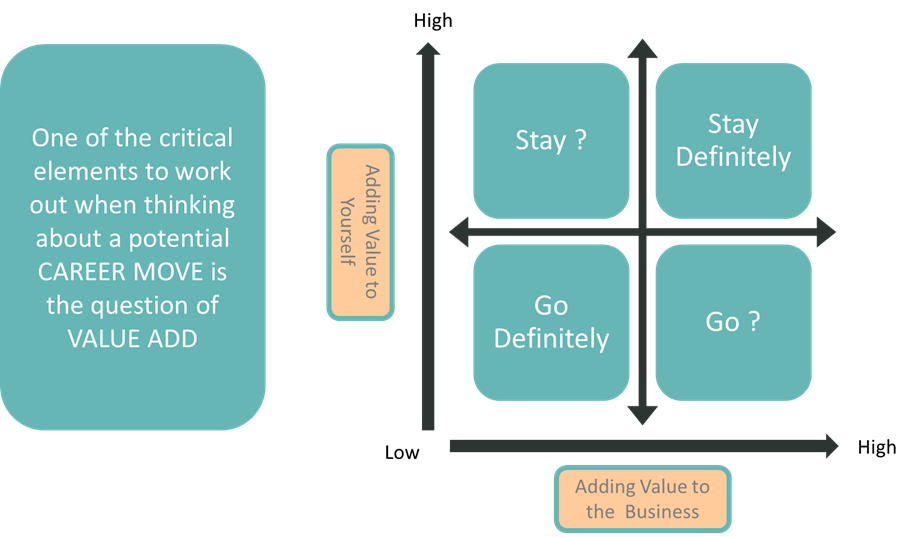
If it gets to a “tipping point” where the employee feels that they have no further option but to consider looking at opportunities outside, then we have developed a simple 2 x 2 to help employees reflect before they take a decision. This can apply at any stage of your career and in any size of organisation.
An individual can assess whether they are adding value to the organisation and /or to themselves and use the matrix to help them consider their options.
Checklist
We would advocate starting with a simple checklist approach for both them and organisations (2 columns) to ascertain what the attributes of value add are and how they scale it.
Typical attributes for the individual could include training, personal development, flexible hours, diverse work activities, challenging work activities, recognition from peers, recognition from leaders and others.
For the organisation that could be creativity, developing others, growing the business, thought leadership, role modelling, loyalty, flexibility, and many others.
The key enemy for both employer and employee here are prolonged stagnation. It benefits both parties to have a level of dynamism. That keeps the employee motivated and the organisation fresh and challenged.
• Reflections
There are as many opportunities to retain strong employees as there are to lose them, so HR functions and leaders need to reflect on these and resource appropriately – employee “churn” is very expensive and time consuming, as well as unnecessary, particularly if you have a strong culture and capabilities. Work teams need to “play to strengths” of individuals versus “force fitting” them into roles and responsibilities where they are not best suited. Wise teams do this often without knowing they are doing just that!
The “slice off the bottom” performance approach, prevalent in the 90s and noughties, has thankfully, largely been abandoned. It makes no sense, especially with the “gig” economy and the importance of thought leadership.
Employee Power
Employees have considerably more levers than they use to have. The challenge for employers is to understand where the tipping points are and respond accordingly.
They should provide every employee some access to career development, not just through training and CPD but through coaching.
Coaching
The traditional thinking that only executives need coaches is now dead.
Coaching is for all, and if you are going to nurture new talent that you have invested considerable resources in through recruitment and early training, then you need to have a coaching system or approach.
Some favour internal coaches, which have the benefits of consistency and are particularly good for performance, but external coaching providers, can provide objectivity and more diverse experience and thinking.
This article was written by: Team Coaching Boutique®
Leave a Reply